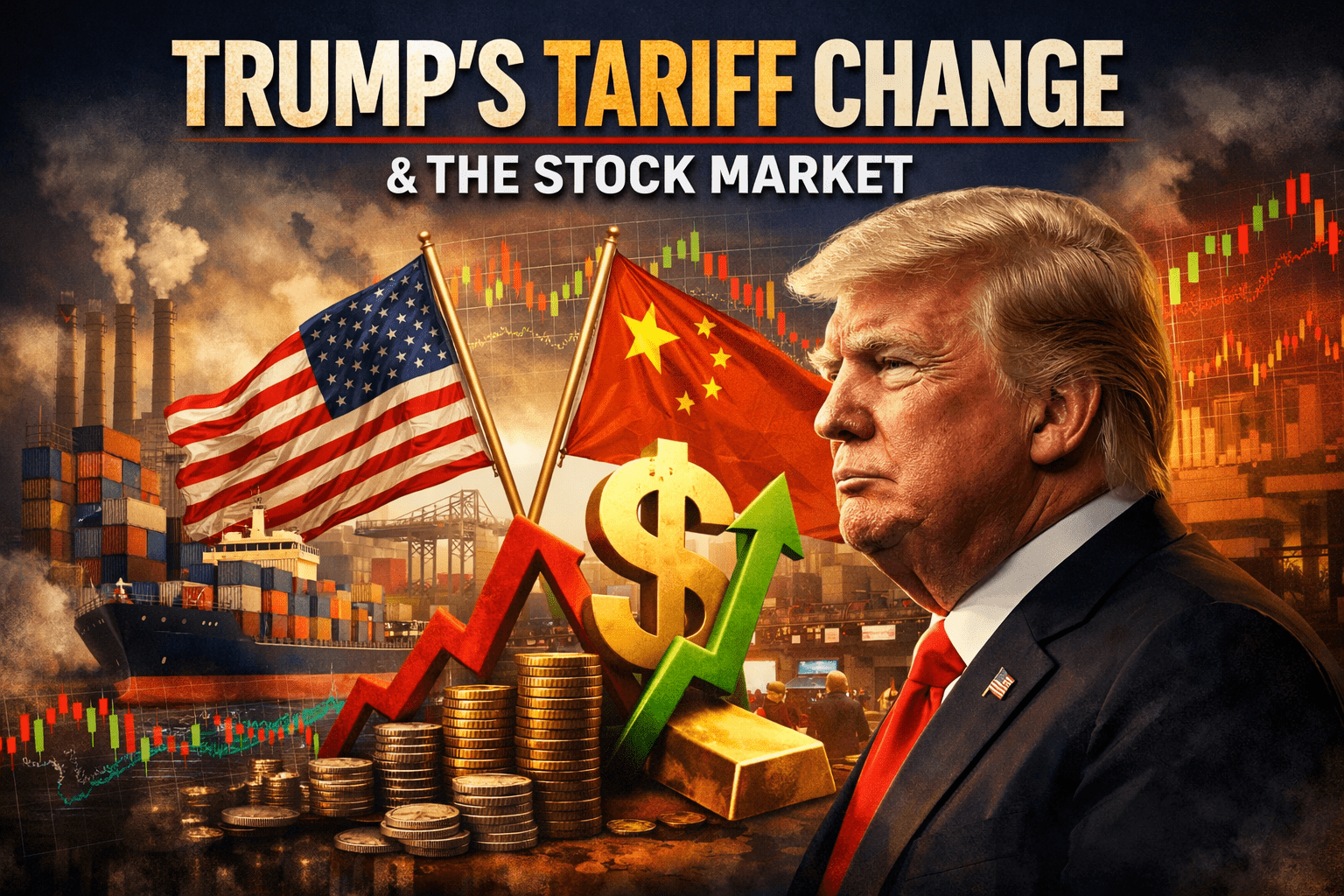
Recent changes to President Trump’s tariff policy have introduced fresh volatility into the stock market. After a court decision limited parts of the previous tariff framework, a revised tariff structure was announced under different legal authority. While the stated goal is to protect domestic industries and address trade imbalances, markets tend to react less to political intent and more to economic impact and uncertainty. As a result, investors have been reassessing earnings expectations, inflation risks, and global trade flows.
Broad market indexes initially reacted with sharp swings. The Dow Jones Industrial Average experienced significant intraday declines as traders priced in the possibility of higher import costs and slower global growth. The S&P 500 and Nasdaq Composite also pulled back, reflecting widespread concern across multiple sectors. Markets dislike uncertainty, and rapid changes to trade policy can make it difficult for companies to forecast costs, margins, and supply chain stability. Even when the long-term impact is unclear, the short-term reaction is often increased volatility.
Some areas of the market, however, may benefit from renewed tariffs. Domestic manufacturers that compete with imported goods could see improved pricing power if foreign competitors face higher costs. Certain industrial and materials companies may gain if tariffs successfully redirect demand toward U.S.-based production. Energy producers could also benefit indirectly if domestic infrastructure investment rises in response to broader economic nationalism. In these cases, investors may anticipate stronger revenue growth or margin expansion.
Technology stocks face a more complicated outlook. Large multinational tech companies generate substantial revenue overseas and rely heavily on global supply chains. Higher tariffs can increase hardware production costs, disrupt sourcing, or invite retaliatory trade measures from other countries. Semiconductor companies, consumer electronics firms, and hardware manufacturers are particularly sensitive to cross-border trade friction. As a result, many tech stocks could experience pressure, especially if other countries respond with counter-tariffs.
Retailers and consumer discretionary companies are also vulnerable. Businesses that import apparel, footwear, electronics, and household goods often operate on thin margins. If tariffs raise input costs, companies must either absorb those costs or pass them along to consumers. Passing them along can reduce demand, while absorbing them can compress profits. Investors typically discount retail stocks when trade tensions rise because earnings visibility becomes less certain.
Financial markets also tend to reprice inflation expectations when tariffs increase. If import costs rise broadly, consumer prices may follow. Higher inflation expectations can push bond yields upward, which in turn affects equity valuations. Growth stocks, particularly in the technology sector, are sensitive to rising interest rates because their valuations depend heavily on future earnings. If bond yields climb, high-growth stocks may face additional downward pressure.
At the same time, certain defensive sectors could see relative stability or even gains. Utilities, healthcare companies, and consumer staples businesses often perform better during periods of economic uncertainty. Their revenues tend to be more stable, and investors may rotate into these areas when cyclical sectors appear risky. Gold and other traditional safe-haven assets can also attract attention during trade disputes, reflecting a broader shift toward capital preservation.
One of the biggest factors influencing markets is not the tariffs themselves, but the uncertainty surrounding their duration and scope. If businesses believe the policy will be short-lived or subject to negotiation, the market impact may remain limited. However, if tariffs expand, trigger retaliation, or become embedded in long-term trade policy, the effect on corporate earnings and global growth could be more substantial. Markets constantly attempt to price these probabilities in real time, which explains the rapid swings following policy announcements.
In summary, the recent tariff adjustments introduce both potential winners and losers across the stock market. Domestic-focused industrial firms may benefit, while multinational technology companies and import-dependent retailers face higher risks. Broad indexes are likely to remain volatile as investors digest inflation data, earnings guidance, and further policy developments. Ultimately, the degree of clarity and consistency in trade policy will play a major role in determining whether markets stabilize or continue to fluctuate in response to tariff headlines.
The above content was written by AI with some help from me.
After I pushed it around a bit I finally got some predictions. That response is below.
Recent changes to President Trump’s tariff policy are likely to move markets in ways that follow clear historical patterns. When tariffs rise suddenly, stocks usually react in two phases. First comes volatility, as investors try to understand how long the policy will last and how companies will absorb higher costs. Then the market begins separating likely winners from likely losers based on exposure to imports, supply chains, and pricing power.
In the short term, major indexes like the S&P 500, Nasdaq, and Dow Jones Industrial Average are likely to remain volatile. Historically, tariff shocks have produced swings of several percentage points in both directions within weeks of the announcement. The Nasdaq tends to move more than the broader market because technology companies rely heavily on global supply chains. If the current tariff structure remains in place, expect wider price ranges and continued headline-driven trading over the next one to two months.
Looking at sector performance during past tariff cycles, industrial and materials companies have often outperformed the broader market. When tariffs protect domestic producers, U.S.-based manufacturers can gain pricing power against foreign competitors. Companies involved in construction materials, heavy equipment, and domestic infrastructure typically benefit if demand shifts inward. Energy infrastructure firms may also see relative strength if manufacturing activity increases domestically.
On the other hand, history shows that consumer discretionary and retail companies tend to struggle during sustained tariff periods. Many retailers depend on imported goods and operate with tight margins. When tariffs increase costs, they either raise prices and risk losing customers or absorb the costs and reduce profits. In previous tariff environments, these stocks have underperformed the broader market, sometimes by a meaningful margin over several months.
Technology hardware and semiconductor companies are also vulnerable. These businesses depend on complex global supply chains and overseas manufacturing. Tariff increases can raise production costs and disrupt sourcing. During prior trade conflicts, hardware-focused tech companies often lagged, while software and service-oriented tech firms performed relatively better because they are less tied to physical goods crossing borders.
Over a longer six-to-twelve-month horizon, much depends on whether tariffs remain in place. If they stay elevated for most of the year, history suggests modest upward pressure on consumer prices and tighter corporate profit margins. That environment typically favors defensive sectors such as utilities, healthcare, and consumer staples. Investors tend to rotate toward stable earnings when economic uncertainty increases.
If tariffs are reduced or clearly scheduled to expire, markets usually rebound quickly. Once uncertainty drops and businesses can plan with confidence, growth sectors often recover. In past cycles, clarity alone has been enough to trigger rallies, even before full policy reversals occur.
Based on historical patterns, the most likely near-term outcome is continued volatility in major indexes, relative strength in industrial and defensive sectors, and underperformance in retail and hardware technology. The longer-term direction will depend less on the tariff rate itself and more on how permanent the policy appears to investors. Markets price certainty faster than they price politics.